


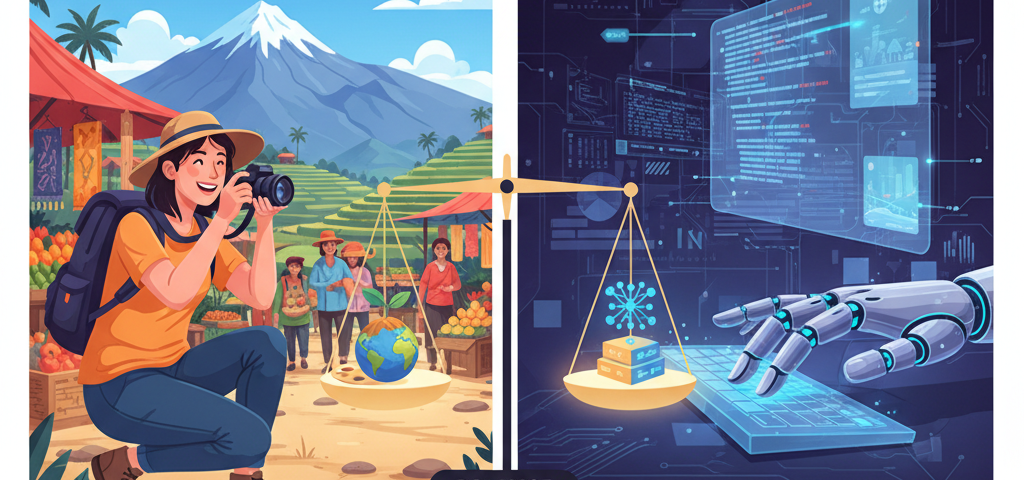
In October 2023, the digital ground shifted beneath the feet of the travel industry. For years, travel bloggers had played a predictable game of cat and mouse with search engines, optimizing keywords and tweaking headlines to capture the wanderlust of the internet. Then came the Google Core Update of October 2023, an algorithmic extinction event that many creators describe simply as having “decimated” their businesses.
The culprit wasn’t just a tweak in code; it was the rising tide of Artificial Intelligence. Suddenly, the internet was flooded with “slop”—millions of AI-generated articles on “Top 10 Things to Do in Bali,” written by bots that had never tasted Nasi Goreng or felt the humidity of an Indonesian afternoon. Google, in a desperate attempt to filter out the noise, swung its hammer wild and hard, crushing independent creators alongside the content farms.
At the Marketing Summit at World Travel Market, a panel of veteran creators and tech experts gathered not to mourn the “golden age” of blogging, but to map the new terrain. Led by Michael Ball of Traverse Events and featuring Malcolm Archer of Stay22, along with creators Cora Harrison, Julie Falconer, and Felipe Morado Gomez, the session revealed a stark new reality: In a world drowning in synthetic text, the most valuable currency left is the messy, imperfect, and undeniable experience of being human.
The Great AI Experiment: A Case Study in Failure
The fear gripping the industry was palpable: If a robot can write a travel guide in three seconds, why does anyone need a travel blogger? Felipe Morado Gomez, a veteran Portuguese creator with 20 years in the game and 4 million annual readers, decided to test this fear directly.
“I decided to try to create a website purely with AI-generated content,” Gomez confessed to the audience. His hypothesis was brutally pragmatic: “If it works, it’s easy money. If it doesn’t work, perfect, it means I can keep doing my normal travel blogging thing.”
He bought a promising domain name and unleashed the bots, generating dozens of articles like “The Best Resorts for Weddings in Bali.” Initially, the results were terrifyingly good. “The first few days actually the articles ranked,” Gomez noted. The algorithm had been tricked. But then, the correction came. As Google’s systems re-evaluated the “value” of the content, the site flatlined. “They disappeared completely,” Gomez said with a smile. “And I was happy about it.”
The experiment validated a crucial theory: AI can mimic structure, but it cannot mimic context. It was, as Malcolm Archer of Stay22 noted, taught on law and scientific papers—disciplines of rigid structure, not the chaotic nuance of travel. The disappearance of Gomez’s AI site proved that “good content” based on first-hand experience is essential for long-term survival. The “human premium” is real.
Diversification is Survival: Escaping the Google Stranglehold
While the AI experiment offered hope, the October crash taught creators a harsh lesson about reliance. Cora Harrison, the founder of Inside Our Suitcase, recalled the dark days of the pandemic when her revenue plummeted to $20 a month. When the Google updates hit later, she realized she could no longer put all her eggs in the search engine basket.
“Google cannot tell what is authentic content and what is AI content… they are pushing down websites… to prioritise user generated content,” Harrison explained.
The solution was a radical pivot in how creators view social media. For years, Instagram and TikTok were treated as vanity platforms—places to post pretty pictures while the “real business” happened on the blog via SEO. Harrison flipped the script. She stopped waiting for Google to send her readers and went out to get them herself.
“I’m now able to use those social platforms… to push audiences to my website,” Harrison said. By treating social media as a marketing funnel rather than a standalone gallery, she diversified her traffic. She now runs Facebook ads on her videos and secures brand partnerships that don’t rely on search rankings.
Julie Falconer, known as A Lady in London, echoed this sentiment with a warning about “digital sharecropping.” Falconer, who has been blogging since 2007, views her 450,000 Instagram followers not as her audience, but as her lead generation.
“My Instagram account is my biggest marketing channel for my blog,” Falconer stated. “Instagram can shut you down any day of the week… You are a guest on their platform, they own you.”
The creators who are thriving in 2024 are those who use the volatility of social media to feed the stability of an owned website, a platform that cannot be “decimated” by a single algorithm update or a banned account.
Smarter Monetization: AI as a Weapon, Not a Threat
While creators fight off AI-generated content on the front end, they are beginning to weaponize AI on the back end to make money. This was the core message from Malcolm Archer of Stay22, a Canadian tech startup that has seen 4,000% growth since the pandemic.
The old model of affiliate marketing was static and dumb. A blogger would write a post about a hotel in Paris and hard-code a link to Booking.com. If that link broke, or if Booking.com changed its terms, the revenue died. Worse, it ignored the user’s preference.
“My buddy Ryan… who wants to backpack across Europe… he definitely is going to want to use probably a booking.com link,” Archer explained. “But… a late 30s traveller from Canada with two kids… probably wants family friendly hotels… that’s all inclusive.”
Stay22’s technology uses AI to analyze the user’s profile in milliseconds. When a reader clicks a generic “Book Now” link on a blog, the AI decides where to send them—Expedia, Booking.com, VRBO—based on who is most likely to convert that specific user.
This dynamic approach solves a massive inefficiency in the “buyer journey.” Archer cited an Expedia report stating that buyers consume 160 pages of content before making a decision17. By using AI to shorten that window and present the right booking option instantly, creators are seeing massive revenue jumps without needing millions of new readers.
“It took me five months to reach the amount of money I made last year,” Harrison revealed after switching to this AI-driven model. Even Gomez, a self-described skeptic who took two years to be convinced, admitted it was a “game changer” because “a link is not just a link” anymore.
The Rise of the “Micro-Giant”
Perhaps the most encouraging takeaway from the session was the democratization of revenue. The era where you needed a million monthly hits to make a living is over. Because the “human touch” is now so rare and valuable, smaller, highly authentic audiences are becoming incredibly lucrative.
“Ideally your sweet spot is in the 25k plus monthly,” Archer noted, but added that creators with as few as 1,000 to 5,000 monthly viewers are already hitting significant revenue numbers.
Why? Because trust scales better than clicks. A generic AI article might get a million views but zero bookings because nobody trusts a robot’s recommendation on where to sleep. A human blogger with 5,000 loyal followers who has actually slept in the bed and tasted the breakfast can drive real conversions.
“Authenticity and data driven would be my two [tips],” Archer concluded. “Be authentic. Be yourself… take no shortcuts and then use the data.”
The Only Moat is You
The travel content industry is not dying; it is molting. The generic, SEO-stuffed listicles of the 2010s are being shed, consumed by the AI maw. What remains underneath is something harder, more personal, and surprisingly resilient.
As the session closed, the mood shifted from anxiety to opportunity. The creators on stage had survived the “decimation” not by trying to out-robot the robots, but by doubling down on their humanity. They are taking their own photos, telling their own stories of travel fails and flight delays, and using technology only to amplify, not replace, their voice.
The most disruptive technology of all turns out to be a person telling a true story about a place they actually visited; you can’t automate the feeling of the sun on your face, and you can’t algorithmically generate trust.