


- Leisure’s influence determines travel’s future: plan progression now
- The Middle East: the world’s fastest-rising leisure powerhouse
- From ‘seeing’ to ‘becoming’: the new traveller mindset
- Longer stays and deeper immersion: the opportunity
- Pre-trip immersion: virtual previews for trip planning
- AI-driven travel: seamless, predictive and personalised
- Next steps: how the industry must prepare for leisure travel 2040
- Shaping the road to 2040 at ATM
Leisure’s influence determines travel’s future: plan progression now
By 2040, leisure travel will be more valuable, more purposeful, and more technologically orchestrated than at any point in history, and the choices we make today will define that future.”
Leisure travel underpins global tourism, representing around 80% of global spend and nearly 70% of international arrivals. Its scale gives it unparalleled influence over how the world will explore and connect in the future.
This is why Arabian Travel Market (ATM) 2026 – the Middle East’s flagship international travel industry show, rooted in leisure-travel heritage, is dedicating its theme, ‘Travel 2040: Driving New Frontiers Through Innovation and Technology’, to examining how leisure will evolve over the next 15 years.
The transformation is already taking shape. Boston Consulting Group (BCG) expects global leisure spending to triple to US$15 trillion by 2040, fuelled by rising demand and fast-changing traveller behaviour. Domestic and regional trips will remain dominant, but expectations, planning habits and technological touchpoints are changing at pace.
ATM 2026 will be the platform for the industry to interpret these shifts and plan strategically for what comes next.
The Middle East: the world’s fastest-rising leisure powerhouse
“The GCC is becoming a centre of gravity for leisure tourism, both as a destination and a source of demand.”
The Middle East – the home of ATM – is emerging as one of the fastest-growing and most influential leisure regions globally. According to the ATM Travel Trends Report 2025, regional tourism spending is set to exceed $350 billion by 2030, with inbound arrivals growing nearly twice as fast as the global average.
Saudi Arabia is at the forefront of this rise, targeting 150 million annual visitors by 2030, supported by a $12 billion tourism fund and giga-projects like Red Sea Global, Qiddiya and Diriyah, to name a few. Meanwhile, the UAE continues to set global benchmarks: Dubai welcomed a record 18.72 million visitors in 2024 (DET), followed by 13.95 million in the first nine months of 2025, up 5% year on year.
Qatar, Bahrain and Oman are also accelerating their leisure strategies, spanning wellness, adventure, cultural immersion and future-tech tourism.
BCG identifies rapidly growing outbound tourism markets, including India, China, Saudi Arabia and Vietnam, that will disproportionately shape travel flows through 2040. With unmatched aviation strength, strategic geography and a rapidly diversifying tourism ecosystem, the GCC is perfectly placed to capture this demand. ATM 2026 will explore how the region can convert this momentum into long-term advantage.
From ‘seeing’ to ‘becoming’: the new traveller mindset
“We are moving from an Experience Economy to a Transformation Economy, where the most valuable trips are the ones that change us.”
While growth strategies matter, traveller motivations matter more. Around the world, leisure habits are shifting from simple “seeing” to deeper “becoming” — journeys designed to restore, educate, challenge or personally evolve the traveller.
This movement, known as transformational travel, is rapidly accelerating. The Transformation Travel Council values the US market alone at $208 billion, while the Global Wellness Institute (GWI) places the global wellness economy at $6.8 trillion in 2024, forecast to reach $9.8 trillion by 2029. In the Middle East, the UAE has become the region’s fastest-growing wellness market, now worth $40.8 billion, with wellness tourism contributing $11.26 billion.
Globally, leisure travellers are embracing wellness escapes, nature-based journeys, micro-adventures and culturally authentic experiences. Skyscanner highlights the rise of “immersive escapism,” “culture-coded travel,” and stays where hotels and resorts are destinations in their own right.
In the Middle East, these preferences align naturally with regional strengths, from Saudi Arabia’s desert micro-adventures and the Red Sea’s eco-retreats to the culture-rich itineraries of Sharjah and AlUla, and the rapidly expanding wellness-driven offerings across the UAE.
Longer stays and deeper immersion: the opportunity
“Travellers are choosing fewer trips but staying longer and spending significantly more on each one.”
This type of immersive escapism requires more destination time, which links to another clear trend defining the run-up to 2040 – the rise of longer stays.
Skyscanner’s research uncovered a growing preference for single-destination trips (76.2%) and an increase in average trip length to 13.5 days
A 2025 Skift report cited by BBC Travel supports the argument, revealing travellers are increasingly seeking longer trips to fewer places, prioritising immersion over speed. Flexible work, lifestyle travel and wellness-focused itineraries are reinforcing the shift toward extended getaways.
The GCC is naturally positioned to capture this trend: diverse hospitality, year-round sunshine, culture and nature experiences, mega entertainment districts and improving visa pathways all support longer, deeper leisure travel.
Destinations such as Dubai, Abu Dhabi, Riyadh and Oman are increasingly building integrated ecosystems that make extended stays not only possible, but appealing, with visa rules to facilitate; the new UAE visa rules being one example.
Pre-trip immersion: virtual previews for trip planning
“By 2040, most travellers will explore a destination virtually before they ever step foot in it.”
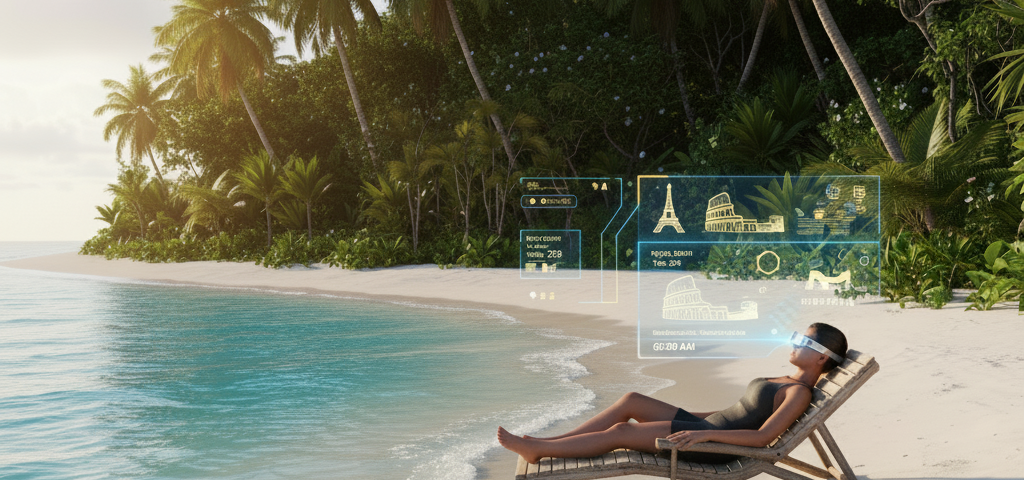
Immersion is also becoming part of the pre-trip experience as travellers turn increasingly to advanced technology for inspiration. Virtual reality, digital twins and interactive preview tools are transforming planning from a functional task into an experiential journey of its own.
Nearly 50% of travellers say they would be more open to visiting a destination if they could experience it virtually first, and what’s more, it’s a profitable marketing path with AR/VR-led content delivering conversion rates up to 94% higher than traditional media. As these tools become more sophisticated, travellers will step inside a resort, take a cultural tour or explore natural landscapes virtually long before they book.
This ‘try-before-you-travel’ model is rapidly gaining traction and will be one of many cutting-edge technologies showcased at Travel Tech @ATM, which debuts as a full co-located show at ATM 2026.
For industry suppliers, these tools reduce uncertainty and increase conversion and for buyers, they unlock richer storytelling, better content accuracy and more compelling itinerary design. By 2040, virtual previews will be a standard expectation, not a novelty; the new fully immersive travel brochure if you like!
AI-driven travel: seamless, predictive and personalised
“AI is becoming the traveller’s most trusted companion — intuitive, intelligent and constantly learning.”
From virtual reality to AI reality – Agentic AI is starting to transform leisure travel more profoundly than any innovation in the last century, personalising every stage of the traveller journey, from inspiration to in-destination assistance.
Skyscanner reports that travellers are becoming increasingly confident using AI to plan and book their trips, rising from 47% in 2024 to 54% in 2025, with 38% expected to use AI to research destinations and 33% to build itineraries by 2026. In the UAE, uptake is even stronger: 60% of travellers say they trust AI to plan their trip, compared with 48% globally (ATM Travel Trends Report).
McKinsey’s latest analysis shows how this transformation is already unfolding. Corporate platforms like SkyLink use agentic AI to analyse thousands of travel options in milliseconds and complete bookings through natural chat, while consumer tools such as Layla draw on behavioural histories to suggest destinations, design itineraries or fulfil open-ended requests like “a family beach break under $10,000”. These early examples offer a glimpse of how AI will soon anticipate needs, personalise choices and manage entire journeys end-to-end.
By 2040, AI will manage search, booking, payment, border processing, real-time optimisation and personalised travel design. For the industry, this requires structured content, modular inventory, open APIs, dynamic pricing and strong data governance. These themes will be central to ATM’s 2040 dialogue.
Next steps: how the industry must prepare for leisure travel 2040
Destinations and tourism boards
- Develop long-stay strategies built around culture, nature, wellness and entertainment.
- Create immersive digital twins and VR tools for pre-trip planning.
- Target high-growth outbound markets, particularly India, China, Saudi Arabia and Vietnam.
Hotels & resorts
- Design modular, personalised, experience-led programmes.
- Expand wellness, transformation-focused and cultural immersion offerings.
- Prepare systems and content for AI-led distribution.
For attractions & experience providers
- Build deeper, purpose-driven, culturally rooted experiences.
- Integrate immersive storytelling and multi-sensory design.
- Use VR/AR previews to boost discovery and conversion.
For travel tech & distribution
- Prioritise structured data and interoperable systems.
- Invest in open APIs and seamless digital ecosystems.
- Strengthen predictive and personalisation capabilities.
For buyers & suppliers at ATM
- Seek partners designing for purpose, depth and AI readiness.
- Source suppliers with strong long-stay and transformational offerings.
- Use ATM 2026 to explore new technologies, align strategies and build future-ready partnerships.
Shaping the road to 2040 at ATM
As the pace of change accelerates, Arabian Travel Market 2026 will be the place where the global industry meets to turn insight into action. Under its 2040 theme, ATM will convene destinations, travel brands, creators and innovators to debate the future of leisure, travel and, crucially, to begin charting the path that will carry the sector into its next era.